Monday, June 4, 2012

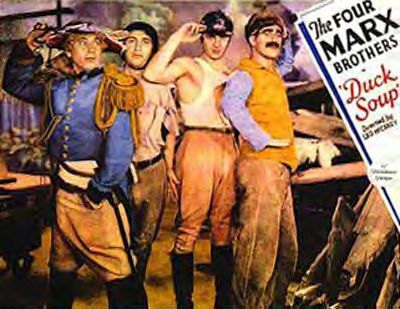
Review of Duck Soup

Number 60 on AFI's list is Duck Soup, a 1933 Marx Brothers political satire.  The action takes place in the fictional country Freedonia, where wealthy plutocrat Ms. Teasdale orders that Rufus T. Firefly, become leader of the country.  Firefly, played by Groucho, proceeds to act like an asshole.  Meanwhile, the leader of neighboring Sylvania hires a couple other Marx Brothers to spy on Firefly.  They too proceed to act like assholes. 

Frankly, I have difficulty seeing how this movie is a political satire.  To me, it seems more of a series of set pieces engineered to feature the brothers Marx acting like assholes.  This isn't to say the movie is bad, I just think it's a little weak in the satire department.  That's also not to say the assholic antics of the Marx Brothers aren't funny, either.  When they act like assholes, they do so not because they're mean or angry.  Their characters have no motivation other than to cause chaos for its own sake. 

What this film has going for it is a series of quick-firing gags and physical comedy.  Amongst these is the oft-imitated mirror gag in which Harpo seemlessly pretends to be Groucho's reflection in a mirror.  What it lacks is a strong plot and, well, political satire.  All in all, I've seen way funnier comedies and many more political satires that are funny because they're true. 
2 1/2 leg-lifts out of 5

Tuesday, April 17, 2012

Review of Sullivan's Travels

...And another giant break between AFI movies.  Anyway, we just watched #61 on AFI's list, a comedy called Sullivan's Travels.  It was released in 1941, directed by Preston Sturges and stars Joel McCrea and Veronica Lake.

The story is about a film director named Sullivan who has grown weary of making schlocky comedies and shallow musicals.  He wants to direct a movie called O Brother, Where Art Thou?, an epic that captures the struggles and plight of the common man.  His collegues chide him for knowing nothing about the struggles of the poor.  Undeterred, he dons hobo clothes and runs away to sample life as a migrant worker.  As he travels, he prompts people to talk about their troubles, but discovers nobody is in a big hurry to bemoan the plight of the common man.  He meets "the Girl", many misadventures occur, many silent-movie comedies are referenced and many lines of dialogue are delivered snappily. 

As an aside, despite bizarre claims by old movie posters for this film which proclaim that "Veronica Lake is on the Take", Veronica Lake at no point appears to be on the take.  I can only assume that this genre-defying movie left studio publicists mystified as to how to market it.  Scratching their heads in confusion, somebody suggested, "We need somethin' that rhymes, see!  Who cares if it don't make sense?"

***SPOILERS AHEAD***

What makes this movie different is that it has a fourth act in its story structure.  After Sullivan and the Girl spend an appropriate amount of time learning hardship and having zany adventures, they return to the studio in triumph.  Normally, a movie might end here.  However, Sullivan decides to don his hobo clothing and repay the poor he lived with a stack of $5 bills.  He is promptly robbed at a trainyard and tossed unconscious onto a departing freight.  His robber is mangled by a train and his corpse mistaken for him.  Meanwhile, the groggy Sullivan lashes out at a railyard guard and is sentenced to six years hard labour.

It is here that the film abruptly changes tone to a drama.  Miserable, overworked and persecuted, he learns real suffering.  He spends a day in the hotbox for reading a newspaper.  At his lowest point, a revival congregation allows the chain gang to watch a Mickey Mouse cartoon in their church.  All his troubles melt away as he howls with laughter at Pluto's antics.  He realizes then that he doesn't want to direct O Brother, Where Art Thou?  He sees that if he wants to help the common man, more good can be accomplished through laughter.

***END SPOILER ZONE***

And that's the message of this movie, recalling the film's dedication at the beginning:
To the memory of those who made us laugh: the motley mountebanks, the clowns, the buffoons, in all times and in all nations, whose efforts have lightened our burden a little, this picture is affectionately dedicated. 

It's a message that could have gone terribly wrong.  For in order to tell the message that "laughter is the best medicine", the film loses all its laughs during the fourth act.  It's risky business and some might accuse it of hypocrisy.  However, in my opinion, the film pulls it off.  Perhaps its hand is heavy, but it is moving in its own way.

It's a pretty good film.  The laughs vary from slapstick to wordplay to high-concept comedy.
4 1/2 unscheduled returns to Hollywood out of 5

Monday, November 8, 2010

Review of American Graffiti

American Graffiti is a coming-of-age flick set in Modesto, California in 1962. It put director George Lucas in the Hollywood spotlight, made him a millionaire, and was nominated for an Academy Award for Best Picture. It inspired the creation of Happy Days. It is also number 62 on AFI's list, hence my watching.

Despite the praise this film has garnered, I found it to be lame. I recognized it instantly as the inspiration for another film I found lame, Dazed and Confused. Both of these films are slice-of-life, nostalgic, plotless, limp and self-indulgent. They both expect that if they feature some vehicles, showcase some stereotypical characters and make you listen to period music, you'll feel so overcome with nostalgia that you'll forget that there's no story. Some nice kid loses his innocence and his world changes forever. Next.

What is interesting about this film is that it is bad in a way much different than George Lucas' later bad work, before he got obsessed with the Hero's Journey, images moving so fast the viewer can barely see what's going on, and computer animation replacing actors. American Graffiti is very personal, not detached like his later work. There is no absurd urge to entertain the shit out of the audience so much that it's grating. Yet American Graffiti is still lame. It's boring in a very un-Lucas-like way.

Here's a question for you all. We are all aware that if a character expresses concern for the well-being of his car in a movie, something bad is going to happen to it before the end of the picture, usually several bad things. Did American Graffiti start this cliche, or was it well-known even by the time of filming?

Part of the problem is that I wasn't alive in 1962. This movie would be much more interesting to somebody who was. This review sounds like I really hated American Graffiti. That's not the case. This movie isn't terrible, it's just meh with a touch of banal. For me, movies are enjoyable if they're so terrible that they're funny. Being meh, banal and wimpy is just completely uninteresting.
2 attempts to pull booze out of 5

Tuesday, October 26, 2010

Review of Cabaret

Next on the list of AFI's movies is Cabaret, #63. It is a loose adaptation of the Broadway musical of the same name, set in the last days of the Weimar Republic in Germany. Liza Minnelli is Sally Bowles, a performer at the Kit Kat Klub in Berlin, who gets entangled in a confused relationship with a visiting English teacher, Brian Roberts (Michael York). The two try to live their decadent lives under the growing shadow cast by the Nazis.

This movie, despite what you may think of it, has actually aged well. Unlike many movies made in the 70's on this list, historical pics included, there are no distracting hallmarks that date it: mainly, the weird hairstyles and sappy/raunchy 70's music. Regardless of the dating and lack thereof, I quite enjoyed it. It has a style all its own. It is a musical where the characters do not spontaneously burst into song. When a character's inner emotions need to be expressed, the scene usually cuts to a relevant musical number at the Kit Kat Klub.

One of the things I like best about this movie is the character of Brian. While Sally Bowles is a familiar character, the artsy, flakey, over-emotional performer who wants to be a real actress, Brian's reactions to her are original. Sally abuses their relationship in the way we would expect, but instead of being driven to violence, the standard Hollywood response, Brian responds with either understanding or his own abuses. He is never a victim and that's refreshing. I won't go into many details for fear of spoilers. Well okay, ***here's a vague SPOILER***: it's very rare that all points of fictional love triangles connect. ***end spoiler alert***

Cabaret contains a scene that is famous in movie history, the powerful "Tommorow Belongs to Me" scene, and I don't feel bad about describing it because it appears in many books on cinema and film school classes. Brian and Maximilian are chatting at an outdoor cafe when a young man stands and begins singing in a beautiful tenor. The cafe-goers are enchanted by the loveliness and earnestness of the song, and perhaps so is the film's viewer. That is until the camera pans downward and we see the young man is dressed in a Nazi uniform. As the cafe's attendees rise in rousing song and Brian and Max skedaddle, I felt the hairs on my back prickling in terror. This scene perfectly encapsulates the madness that led the Nazis to power and the world to war in 1939.

As a side note, this scene once again just goes to show that interpretation of art is all in the eyes of the audience. While the reaction I experienced to this scene was the one, I believe, that the filmmakers intended, it is not so with all audiences. "Tomorrow Belongs to Me" has been embraced as an anthem by White Pride groups. Some people, I tell you.

Cabaret is complicated and heartbreaking (for a musical). Once again, not for all tastes, but it certainly was for mine.
Beedle-dee dee dee dee! 4 1/2 Ladies out of 5, and I'm the only man