Wednesday, January 27, 2010

Review of a Clockwork Orange

Here's another Stanley Kubrick entry on AFI's list. I've seen this movie before and enjoyed it quite a lot. Since then, I've read the book and I'm afraid this viewing confirms my suspicion: the book is just better.


Firstly, there is the fact that this movie was based on a version of the book that was incomplete. For some reason, Anthony Burgess' New York publisher thought that Americans wouldn't get the ending. You know, the part that actually makes the book make sense. If I was an American, I'd be insulted that some New York bigshot thought I was too stupid to understand an ending where somebody decides to give up violence.

And what an ending it missed. Therein is contained a fundamental message of truth. It's about youth. Permit me to quote:

...No, it is not just being an animal so much as being like one of these malenky toys you viddy being sold in the streets, like little chellovecks made out of tin and with a spring inside and then a winding handle on the outside and you wind it up grrr grrr grrr and off it itties, like walking, O my brothers. But it itties in a straight line and bangs straight into things bang bang and it cannot help what it is doing. Being young is like being like one of these malenky machines.

My son, my son. When I had my son I would explain all that to him when he was starry enough to like understand. But then I knew he would not understand or would not want to understand at all and would do all the veshches I had done, yes perhaps even killing some poor starry forella surrounded with mewing kots and koshkas, and I would not be able to really stop him. And nor would he be able to stop his own son, brothers.


This is the message that lies at the heart of A Clockwork Orange. Apologies to Anthony Burgess, who seems to be embarassed of his novella, but I think it's brilliant and truthful writing. It's also not in the movie.


This movie misses yet another fundamental truth, not related to the ending. About mid-film, antihero Alex undergoes brainwashing that makes him feel violently ill whenever he thinks about violence or sex. However, he discovers that because Beethoven's 9th Symphony was playing during the brainwashing, listening to it makes him ill as well. Beethoven's 9th specifically.

Not so in the book. After Alex's brainwashing, all music makes him ill. What Burgess is trying to say is that music taps into violent emotions within the human psyche. It comes from the same place as violence and sex. This may seem like an odd quibble, but it's very important to me as a musician. What was the point of this cinematic change? What difference does it make other than remove an important message from the story?

All this being said, A Clockwork Orange is still a good movie of its own merit, assuming you can stomach the violence and rape. Many of the book's important messages are still tapped and the cinematograpy is fantastic. It revels in that odd feeling of dramatic tension skirting the border between comedy and terror, a tension that Kubrick does very well in his other movies, The Shining and Full Metal Jacket.

4 cracks in the gulliver out of 5

Monday, December 14, 2009

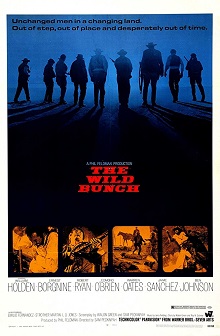
Review of the Wild Bunch

So, it occurs to me that I forgot to write a review for #80 on AFI's list, The Wild Bunch. I forgot to write the review because the movie sucked. Really sucked.


If I was to say that The Wild Bunch is violent, you'd probably say, "What? A violent Sam Peckinpah movie? Get outta town," in a really sarcastic tone. But no, really, it's violent. I wish I could say the violence was shocking in an artistic way, but it's really not. For one thing, they just didn't understand how to make fake blood in the 70's. It looks awful and subtracts from the visceral power that the violence was intended to inspire.

And yes, the violence was intended as artistic. Sam Peckinpah wanted to shock audiences by presenting images that invoked the Vietnam war, which still broadcast awful things into the homes of Americans every night. It's too bad that, aside from the violence being silly instead of artistic, the plot is also stupid. It basically involves several groups of people trying to shoot each other, successfully and in large numbers.

Rarely in movie history have so many unlikeable characters been collected onscreen. There is seriously nobody for whom to root. Pike Bishop, the film's "protagonist" is the leader of a gang of outlaws in the early 20th Century. He is a cold-blooded asshole who cares little for anything but money. His sidekick is Dutch, a cold-blooded asshole who cares little for anything but money. They meet this Mexican warlord, a cold-blooded asshole who cares little for anything but money. Feel free to repeat this process to gain an accurate discription of every character in the movie. The one exception is an outlaw named Angel who, while being a CBAwCLfABM, has mild concerns about the lawlessness of the Mexican Revolution and its effect on his hometown. As such, he is the moral pinnacle of this film's characters, but it's also worth noting that he murders his ex-girlfriend in a jealous rage during the course of the show.

In short, don't waste your time. Excessive violence may have been a cinematic novelty in the 70's, but it's been done many times more successfully and artistically since.

500 dead Mexicans out of 5000

Sunday, December 13, 2009

Review of Saving Private Ryan

The action in Saving Private Ryan begins with the amphibious invasion of Normandy on D-Day in 1944. It is a tremendous, terrifying spectacle that blows your mind, eyeballs and hundreds of GIs out of the water. It is powerful and horrifying. Machine-gun bullets whiz past your ears and kill men struggling in the water. Meat hits the camera. A boy with his guts splashed on the beach screams for his mother. In the end, the Americans exact revenge upon the Germans by murdering them after they've surrendered. It's real, it's bloody, it's all hell. After you watch this scene, you don't want to go to war.


And yet, Saving Private Ryan contains another scene which ruins the effect of the first. At the end of the movie, the Army Rangers sent to find Private Ryan and the Airborne soldiers link up and stage a last-ditch effort to keep the Germans from crossing the only intact bridge left on a river. This too is a powerful scene filled with blood and meaty chunks flying everywhere, but the effect is different. Here, the action makes any red-blooded man wish he could go back in time and kill some Germans.

Why does this happen? I can only assume it's because the later scene is filled with imagery that builds the romance of war. Guys fighting to the end despite all odds, the cinematic nature of the tension built as the advancing armour rumbles and shrieks like some great beast, Captain Miller falling mortally wounded, the return of the released German soldier, all of it was cinematic. Cinematic as opposed to real, like the first battle is. Add some images of fluttering American flags and you have a typical Hollywood-war-is-great-rah-rah-rah picture.


Was this effect intended? If it was intended, then this movie is pretty hypocritical, considering the effect which the first battle inspires in the audience. If I would, I'd like to call your attention to Band of Brothers, HBO's amazing WWII epic about the 101st Airborne Division, Easy Company (Private Ryan's unit, incidentally). As far as I'm concerned, Saving Private Ryan is merely a rehearsal for Band of Brothers. It's made by the same people (Spielberg, Tom Hanks, etc.) It's just better. Why? Because Band of Brothers has the feel of that first scene of Saving Private Ryan and never descends into flag waving and letting flow the Hollywood sap. It's real, and because it stays real, it's more effective. Normal men become heroes not because they gun down Nazis by the thousand, give speeches about freedom and come up with plans so crazy that they might just work. They are heroes because they lived through all war's bullshit so the rest of us didn't have to. When Band of Brothers is over, you want to travel back in time, not to kill Germans, but to share a beer with those paratroopers and thank them.

All that said, despite the hypocrisy, Saving Private Ryan is okay.

4 brothers killed out of 5

Review of The Shawshank Redemption

The Shawshank Redemption is, according to the Internet Movie Database, the best movie of all time. It has stayed in that spot on the IMDb's list for most of the database's life, and I suspect it will be there for years to come. How odd that this movie was an unpopular choice with theatre-goers when it was first released.


I saw this film for the first time in 1994 at the long-gone Paradise Theatre in Saskatoon. In those days the Paradise stayed alive by showing double-features, and as I recall the first feature was Legends of the Fall. Let's say that after that particular monsterpiece, I was in barely a mood to enjoy yet another epic. But Shawshank won me over.

This was the movie that established Morgan Freeman as Hollywood's narrator of choice. After this, producers, being an unimaginative lot, could only think of him when they wanted somebody to talk about penguins or parapelegic boxers.

Also making a familiar appearance in this show is the Stephen King villain. In Shawshank, he appears as Warden Norton and Chief Hadley. The way you can identify a Stephen King villain is that he's a character with no redeeming personality traits whatsoever.

There was something about the dialogue in this show that struck me as being very similar to Titanic. It was a clunkiness that comes from uneducated characters waxing poetic when the screenwriter needs them, but saying really obvious, cheesy things at other moments.

You know, looking back on this review, it looks like I didn't like this show very much. But you know what? I did. I don't think it's the greatest movie ever made, but I still remember how the movie thrilled me when we discover what happened to Andy Dufresne the night he smuggled rope into his cell. While the dialogue may seem cheesy at times, there is enough poetry in it to keep me satisfied. Lastly, the ending is very satisfying.

4 rocks that have no business being in a Maine hayfield out of 5